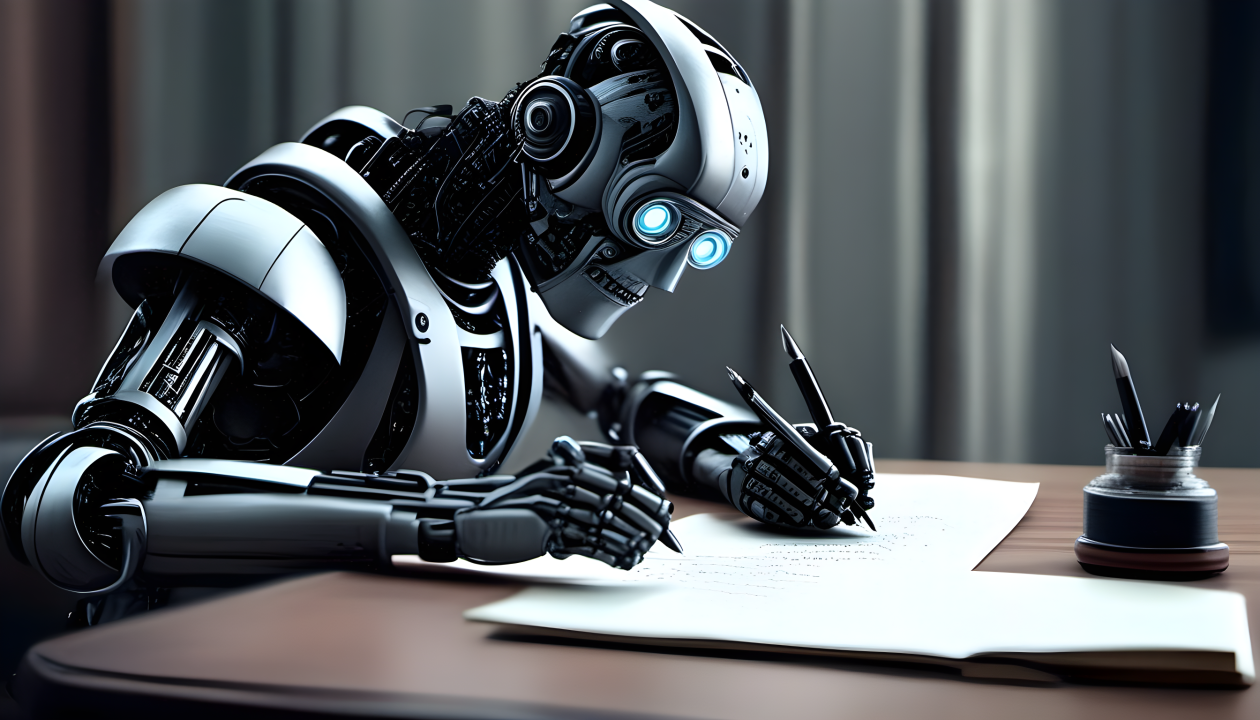
Can Artificial Intelligence Replace Human Writers?
A decade ago, the idea of a machine writing a novel or a news article seemed like science fiction. Today, it is a reality. AI tools can draft emails, generate marketing copy, produce news summaries, and even compose poetry. The question is no longer whether AI can write, but whether it can replace the humans who have built careers and identities around the craft of writing. With AI-generated content reaching 52% of all online material in 2025, and nearly 90% of content marketers expected to use AI in the same year, the shift is undeniable. But writing is not just about stringing words together. It involves creativity, emotion, lived experience, and the ability to connect with readers on a human level. This post explores whether AI can truly replace human writers or whether the future lies in collaboration. We will examine what AI does well, where it falls short, what the evidence from recent studies reveals, and what this means for the future of the writing profession.
Frequently Asked Questions
Are human writers at risk of being replaced entirely by AI?
The evidence suggests that some writing jobs will be significantly affected, but full replacement is unlikely for most creative and complex writing roles. AI excels at formulaic, high‑volume tasks like product descriptions and basic news summaries. However, writing that requires genuine creativity, emotional depth, investigative reporting, or a unique personal voice remains firmly in the human domain. The greatest risk is not replacement but devaluation, as AI‑generated content floods the market and puts downward pressure on incomes.
Can Readers tell the difference between Human and AI writing?
In many cases, yes. Stylometric studies have shown that AI writing carries a detectable stylistic fingerprint, with AI models producing more uniform, predictable prose while human writing remains varied and idiosyncratic. On social media, AI‑generated posts can be distinguished with 70‑80% accuracy, largely because AI struggles to replicate authentic emotional expression. However, when AI is fine‑tuned on a specific author's complete works, readers may struggle to distinguish the difference.
What should writers do to adapt to the rise of AI?
Writers should treat AI as a tool, not a threat. Use AI for brainstorming, research, transcription, and overcoming writer's block. Use it to draft routine content that you would otherwise write manually. But always edit, personalise, and add your own voice. The most successful writers will be those who leverage AI for efficiency while doubling down on what makes their writing uniquely human: lived experience, emotional authenticity, and a distinctive perspective that no algorithm can replicate.
The Rise of Artificial Intelligence in Writing
AI writing tools have moved from experimental to essential. Nevertheless, in 2025, 90% of content marketers used AI, up from 64.7% just two years earlier. In journalism, 87% of newsroom managers reported that AI had completely or partially changed their operations, with 81.7% of journalists already using AI tools in their work. Furthermore, these numbers are not incremental; they represent a fundamental shift in how writing work is done. AI writing tools offer clear advantages. They are fast, producing drafts in seconds. They are scalable, handling thousands of product descriptions or social media posts without complaint. However, they are cost-effective, reducing the expense of low‑impact content. And they are increasingly sophisticated, with capabilities that extend to translation, SEO optimisation, and even summarising vast amounts of data.
The numbers are staggering. Additionally, in 2025, AI-generated content hit 48% of all online writing, with projections suggesting it could reach 90% by 2026. News organisations use AI to sift through hours of video footage or vast document libraries, tasks that would be impossible to do manually. Nevertheless, publishers are experimenting with AI‑written books, and platforms like Spines use AI to assist with everything from cover design to publishing. AI is not coming; it is already here.
The Limitations of Machine Writing
A world‑first study from University College Cork, published in Nature, found that AI-generated writing displays a detectable stylistic fingerprint that sets it apart from human prose. AI produces polished, fluent writing, but it follows a narrow and uniform pattern. Nevertheless, human authors display far greater stylistic range, shaped by personal voice, creative intent, and individual experience. Even when AI tries to sound human, its writing still carries a detectable signature. Multiple studies confirm that AI-generated content tends toward homogeneity. Additionally, artificial intelligence models favour high‑consensus outputs, producing texts that are statistically average rather than genuinely innovative. A study on creative writing found that AI‑assisted stories displayed a noticeable trend toward uniformity, raising concerns about the erosion of cultural diversity. When artificial intelligence writes, it writes like everyone else.
AI struggles with genuine emotional expression. However, a study of social media posts found that AI‑generated content was distinguishable from human writing with 70‑80% accuracy, largely because AI models fail to capture the spontaneity and emotional depth of human interaction. Researchers noted that AI's responses were consistently less "toxic" than human replies, revealing an inability to replicate authentic emotional range. While AI can mimic emotion, it does not feel it. Perhaps the deepest limitation is that artificial intelligence does not understand what it writes. It operates on statistical patterns, not meaning. It cannot draw on lived experience, personal memory, or genuine insight. When a human writer describes grief, they draw on having grieved. When AI describes grief, it is assembling words that statistically co‑occur with the concept. This is not understanding; it is pattern matching.
The flood of AI‑generated content has created a parallel crisis of consent. In 2025, Anthropic agreed to pay up to $1.5 billion to thousands of authors after a judge ruled the company had infringed copyright. A Cambridge report found that 59% of novelists knew their work had been used to train AI models without permission or payment. This is not just a legal issue; it is an ethical one. Artificial intelligence writes because it was fed human writing, often without the human's consent.
What Writers Bring That Artificial Intelligence Cannot.
1. Authentic Voice and Lived Experience: Human writing emerges from a life lived. It carries the weight of experience, the nuance of memory, and the authenticity of feeling. Neuroscientist David Eagleman argues that AI cannot produce the surprise that comes from a unique point of view, and that readers will always crave stories that reflect genuine human experience. A novel written by a machine may be structurally perfect, but it lacks the soul of a human story.
2. The Trust Factor: In journalism and publishing, trust is paramount. Audiences are already sceptical of online information, with 58% of people no longer trusting online content. If writing is known to be AI‑generated, readers disengage. As one writer put it, "the moment people know something was written by artificial intelligence, they will stop reading or watching it". Trust cannot be automated; it must be earned through transparency, accountability, and human connection.
3. The Ceiling of Machine Creativity: While AI matches average human performance on some creativity tests, it rarely reaches the highest levels. A study of 14 major LLMs found that while models performed better than the average human on certain creativity assessments, only 0.28% of AI‑generated responses reached the top 10% of human creativity benchmarks. The ceiling of machine creativity appears to be competence, not genius. The truly exceptional writer remains irreplaceable.
4. The Collaborative Future: The most compelling evidence suggests that AI will not replace writers, but will change how they work. Hybrid human‑AI teams produce better results than either working alone. One study found that when writers used AI as a tool for brainstorming, research, and editing, their output improved without losing their distinctive voice. The future is not writer versus machine, but writer with machine.
Wind Up
Can artificial intelligence replace human writers? The evidence points to a nuanced answer: AI can replace some writing, but not all. It excels at repetitive, formulaic, high‑volume tasks. It can draft, summarise, and generate at scale. But it cannot replicate the authentic voice, lived experience, emotional depth, and creative originality that define great human writing. The future of writing is not a battlefield where machines triumph over humans. It is a workshop where both contribute. AI handles the mundane: the first drafts, the SEO optimisation, the data summaries. Humans focus on the meaningful: the storytelling, the emotional connection, the unique perspective that no algorithm can generate. The writers who thrive will be those who learn to use AI as a tool, not those who fear it as a replacement.
Comments